Version française ; Version anglaise ; Bibliographie.
Voir également l’appel sur le Carnet de recherche des musées d’Orsay et de l’Orangerie.
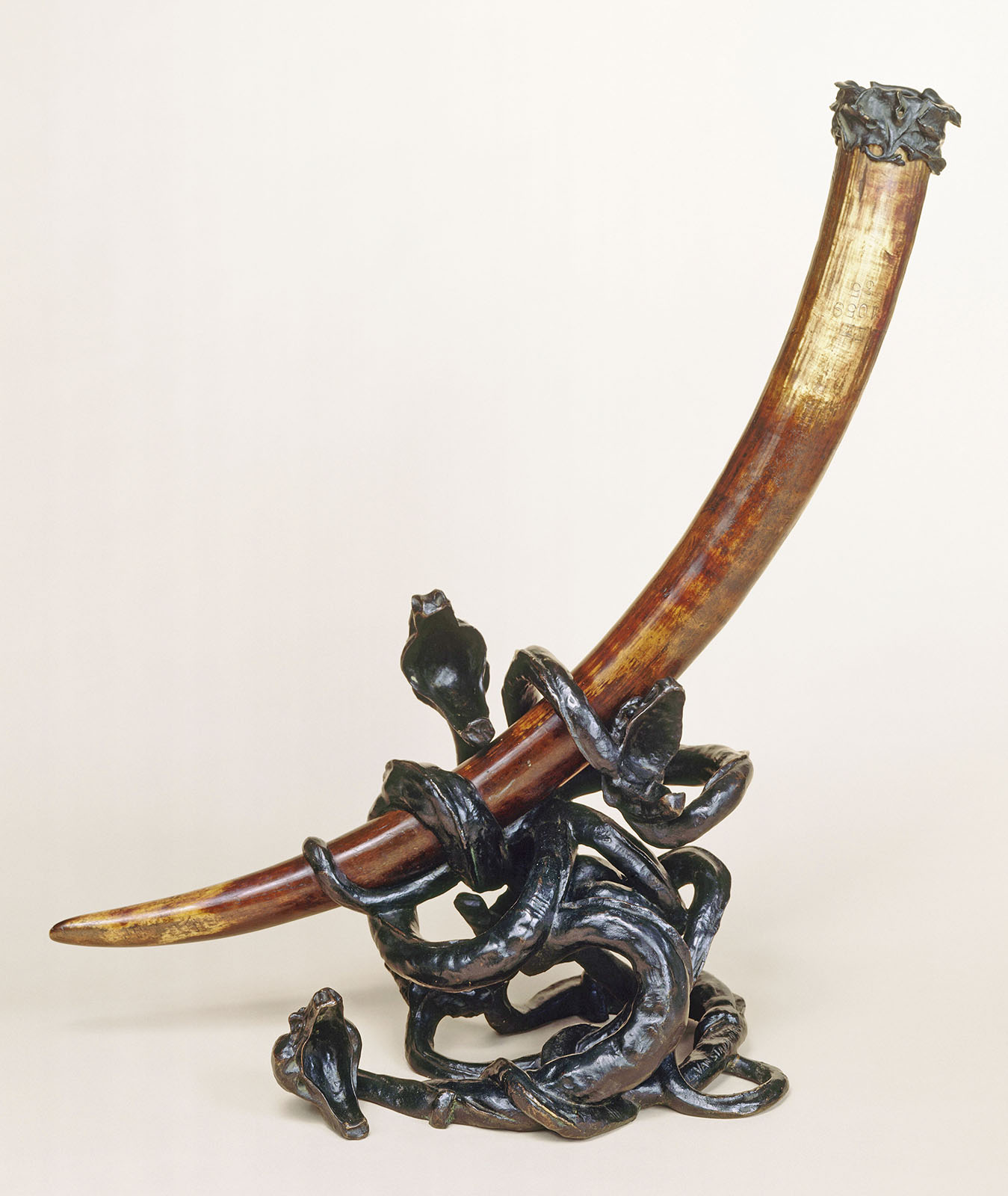
Léopold Van Strydonck, La Lutte du Bien et du Mal, 1897
Ivoire (défense d’éléphant montée), bronze, hauteur 76 cm
Paris, musée d’Orsay, achat, 1989, OAO1182
Photo © GrandPalaisRMN (musée d’Orsay) / Hervé Lewandowski
Version française
48-14. La nouvelle revue scientifique des musées d’Orsay et de l’Orangerie, no 2, 2027
Argumentaire
En 1884, John Ruskin donne une conférence sur ce qu’il nomme le « nuage d’orage du dix-neuvième siècle », désignant à la fois un nouveau type de pollution atmosphérique liée à l’industrialisation et, de manière métaphorique, le signe d’une époque troublée. Ce diagnostic résonne profondément avec les préoccupations des artistes de la fin du XIXe et du début du XXe siècle. Témoins d’un monde en pleine mutation, ils traduisent dans leurs œuvres une ambivalence caractéristique de l’époque : l’inquiétude face à la transformation des milieux se mêle à la curiosité, voire à l’exaltation, que suscitent les nouvelles matières, énergies et techniques offertes par la modernité.
Depuis une vingtaine d’années, le tournant environnemental (environmental turn) en histoire de l’art (Thomas, 2000 ; Mathis, 2005 ; Michalsky et Nova, 2009 ; Eisenmann, 2010 ; Zhong Mengual, 2021), nourri notamment par les travaux de Philippe Descola, a conduit à élargir la perspective de l’histoire de l’art en intégrant les écosystèmes dans lesquels l’art s’inscrit et agit. Les chercheurs examinent plus attentivement les productions artistiques dans leurs interactions avec le vivant, l’environnement et la matière. Parallèlement, le tournant matériel (material turn), depuis les années 1990, a replacé la matière au centre des réflexions sur les œuvres. Celles-ci ne sont plus seulement appréhendées comme images ou représentations, mais comme de véritables « choses » (Brown, 2001), inscrites dans des réseaux techniques, économiques et sociaux (Latour, 1991, 2005) et dotées de propriétés intrinsèques (Ingold, 2007). Dans ce cadre, la théorie de l’agentivité (agency) développée par Alfred Gell (1998) a renouvelé la compréhension des objets artistiques en les considérant comme des agents capables d’agir sur le monde et sur les relations humaines.
Ces approches se rejoignent de manière féconde : l’histoire environnementale de l’art implique la question de la matière, qu’elle soit vivante ou inanimée, tandis que l’étude de la matérialité des œuvres conduit à interroger les enjeux environnementaux de la création artistique, liés à l’extraction, à la transformation, à la circulation, à l’usage et à la conservation des matériaux (pigment, pierre, bois, métal, textile, verre…), ainsi qu’à l’exploitation des ressources naturelles (eau, charbon…). L’attention portée aux matériaux ouvre donc une réflexion sur leur impact sur les milieux naturels et humains, mais aussi sur leur propre vulnérabilité, leur conservation et leur devenir.
Le deuxième numéro de 48-14 propose d’explorer ces questions dans une perspective d’histoire de l’art à la fois pluridisciplinaire (arts visuels, arts décoratifs, architecture, photographie, cinéma…) et globalisée, en se concentrant toutefois sur la période des collections des musées d’Orsay et de l’Orangerie, soit de 1848 à 1927.
Seront privilégiées les propositions qui articulent, autour d’objets précis, des réflexions sur les diverses manières dont les artistes conçoivent le lien entre matière et environnement, qu’il participe à la construction de l’opposition entre nature et culture (Descola, 2005) ou, au contraire, à sa remise en cause. Nous invitons vivement les chercheurs à soumettre des propositions d’articles portant sur l’ensemble des médias artistiques – photographie, cinéma, arts décoratifs, architecture, sculpture, peinture et arts graphiques. Le comité de rédaction veillera, dans sa sélection, à maintenir un équilibre entre ces différentes disciplines. Cet appel s’adresse à des chercheuses et chercheurs à tous les stades de carrière, en provenance de tous les horizons professionnels concernés et de toutes les régions du monde. Pour des questions de coût et d’expertise, les langues de soumission seront néanmoins le français ou l’anglais (voir conditions de soumission ci-dessous).
Le titre proposé pour ce numéro de 48-14 est un titre de travail susceptible d’être modifié.
Axes possibles (non exhaustifs)
1. Ressources, milieux et conditions matérielles de la création
- Extraction, circulation et transformation des ressources naturelles et industrielles
- Expansion coloniale et appropriation de ressources animales, végétales ou minérales
- Mondialisation des matériaux et de leurs usages artistiques (pigments, papiers, métaux, verres…)
- Rôle de l’atelier comme milieu matériel, sensible et expérimental
- Captation et représentation de la lumière, de l’air et de la transparence
- Transformation accélérée des paysages par les industries extractives et les infrastructures
- Formes artistiques de la perception environnementale et du sentiment de la nature
- Matières animales et enjeux du vivant (exploitation, domestication, extinction)
2. Vie, agentivité et vulnérabilité des matériaux
- Matière comme organisme vivant, lieu de vitalité
- Nouveaux matériaux et effets sur la sensibilité moderne
- Matériaux industriels, transformés, préfabriqués
- Fragilités et limites des matériaux
- Toxicités réelles des matériaux pour l’environnement comme pour les artistes, artisans et ouvriers
- Matérialité et temporalité : altérations, pertes et disparitions
3. Conserver dans un environnement instable
- Premières réflexions écologiques et mouvements de protection de la nature, en parallèle des débats sur la durabilité des œuvres
- Translocation d’œuvres d’art vers des climats différents
- Vulnérabilités accrues face aux catastrophes naturelles et aux dérèglements climatiques (incendies, inondations, humidité, chaleur)
- Effets du changement climatique sur la matière (craquelures, corrosion, décoloration, gonflement, moisissures, destruction)
- Pratiques contemporaines de conservation et de restauration dans un contexte de changement climatique
- Stratégies alternatives : répliques, moulages, photographies, reconstructions virtuelles, reproductions numériques et leurs impacts environnementaux
La revue 48-14
48-14 est la revue historique du musée d’Orsay. Publiée de 1995 à 2011, elle renaît en 2026 dans une nouvelle formule : annuelle, elle existera dans une version imprimée en français ainsi que dans une version numérique entièrement bilingue, en français et en anglais, en accès libre et gratuit. Cette relance est marquée par l’élargissement du champ chronologique couvert par la revue, intégrant désormais celui des collections du musée de l’Orangerie, et par la création du Centre de ressources et de recherche Daniel Marchesseau des musées d’Orsay et de l’Orangerie qui réaffirme la volonté des musées de poursuivre et renforcer leur engagement pour la recherche. Chaque numéro contient un dossier thématique constitué d’articles réunis à partir d’appels à contributions. La revue entend ainsi impulser, soutenir et diffuser la recherche en histoire de l’art entre 1848 et 1927, tous médias confondus.
Rédactrice en chef : France Nerlich (Centre de ressources et de recherche Daniel Marchesseau des musées d’Orsay et de l’Orangerie)
Rédactrice en chef invitée pour le 2e numéro : Servane Dargnies-de Vitry (musée d’Orsay)
Modalités de soumission
Les réponses à cet appel à contributions comprendront :
- Un résumé de 4 000 signes (espaces et notes comprises, références bibliographiques abrégées, sur un document Word) précisant l’objet, la problématique, le caractère inédit, les hypothèses principales, un titre provisoire
- Les sources et références bibliographiques
- Sur un document séparé : une biographie de l’autrice ou de l’auteur d’environ 1 500 signes, accompagnée d’une liste des travaux les plus significatifs
Les propositions, qui pourront être rédigées en français ou en anglais, seront à envoyer à l’adresse 48-14@musee-orsay.fr au plus tard le 30 janvier 2026. Le comité de rédaction de la revue sélectionnera entre six à huit propositions, en veillant à la représentativité des domaines. Les autrices et auteurs seront informés de sa décision en mars 2026.
Les articles définitifs devront être remis pour le 15 octobre 2026. Les textes (25 000 signes, notes et espaces comprises) feront ensuite l’objet d’une évaluation par les pairs.
La revue prendra en charge les traductions ainsi que la collecte iconographique et la clarification des droits.
Calendrier
Réponses à l’AAC : 30 janvier 2026
Sélection par le comité de rédaction : mars 2026
Remise des textes : 15 octobre 2026
Retours du Comité de rédaction sur les textes : janvier 2027
Publication : octobre 2027
Version anglaise
“Art, Matter and Environment (1848–1927)”
48-14. La nouvelle revue scientifique des musées d’Orsay et de l’Orangerie, no 2, 2027
Deadline for the submission of proposals: 30 janvier 2026
The Theme
In 1884, John Ruskin gave a lecture on what he called the “storm-cloud of the nineteenth century,” indicating both a new type of atmospheric pollution linked to industrialization and the sign of a troubled era. The critic’s diagnosis resonates deeply with the concerns of artists at the end of the nineteenth and the beginning of the twentieth century. Witnesses to a world in full transformation, through their works they conveyed an ambivalence characteristic of the period. Anxiety over the transformation of the environment mingled with curiosity, even exhilaration, stirred by new materials, energies, and techniques offered by modernity.
Over the past twenty years, the environmental turn in art history (Thomas, 2000; Mathis, 2005; Michalsky and Nova, 2009; Eisenmann, 2010; Zhong Mengual, 2021), nourished in particular by the work of Philippe Descola, has led to a broadening of art history’s perspective by considering the ecosystems within which art is situated and operates. Researchers now attentively examine artistic production as it interacts with living beings, the environment, and matter. At the same time since the 1990s, the material turn has placed matter back at the center of art critical and art historical analysis. No longer apprehended solely as images or representations, works of art are examined as genuine “things” (Brown, 2001), inscribed in technical, economic, and social networks (Latour, 1991, 2005) and endowed with intrinsic properties (Ingold, 2007). Within this framework, the theory of agency developed by Alfred Gell (1998) has renewed the understanding of artistic objects by considering them as agents capable of acting upon the world and human relations.
These approaches converge fruitfully. The environmental history of art necessarily involves the question of matter, whether living or inanimate, while the study of the materiality of artworks leads to an examination of the environmental stakes of artistic creation. These issues relate to the extraction, transformation, circulation, use, and conservation of materials (pigment, stone, wood, metal, textile, glass, etc.), as well as the exploitation of natural resources (water, wood, charcoal, etc.). Attention to materials thus opens a reflection on their impact on natural and human environments as well as on their own vulnerability, their conservation, and their future.
The second issue of 48-14 will explore these questions from a perspective in art history that is both multidisciplinary (visual arts, decorative arts, architecture, photography, film, etc.) and globalized, while at the same time focusing on the period covered by the collections of the Musée d’Orsay and the Musée de l’Orangerie, that is, from 1848 to 1927.
Priority will be given to proposals that concern specific objects and discuss various ways in which artists conceive of the relationship between matter and environment—whether this relationship challenges or bolsters the supposed opposition between nature and culture (Descola, 2005). We enthusiastically seek proposals over a wide gamut of artistic media, including photography, film, decorative arts, architecture, sculpture, painting, and the graphic arts. In its selection the editorial board will ensure a balance among these different fields. Our call is addressed to researchers at all career stages, from all relevant professional backgrounds, and from all regions of the world. For reasons of cost and expertise, submissions must nevertheless be in French or English (see submission conditions below).
The proposed title for this issue of 48-14 is a working title and may be modified.
Possible Axes (non-exhaustive)
1. Resources, environments, and the material conditions of creation
- Extraction, circulation, and transformation of natural and industrial resources
- Colonial expansion and appropriation of animal, vegetal, or mineral resources
- Globalization of materials and their artistic uses (pigments, papers, metals, glass, etc.)
- The role of the studio as a material, sensory, and experimental environment
- The capture and representation of light, air, and transparency
- Accelerated transformation of landscapes by extractive industries and infrastructures
- Artistic forms of environmental perception and of the feeling for nature
- Animal materials and issues related to the living (exploitation, domestication, extinction)
2. Life, agency, and the vulnerability of materials
- Matter as a living organism, a site of vitality
- New materials and their effects on modern sensibilities
- Industrial, transformed, prefabricated materials
- Fragilities and limits of materials
- The toxicity of materials for the environment as well as for artists, artisans, and workers
- Materiality and temporality: alterations, losses, and disappearances
3. Preservation in an unstable environment
- Early ecological reflections and movements for the protection of nature, in parallel with debates on the durability of artworks
- Translocation of artworks to different climates
- Heightened vulnerabilities in the face of natural disasters and climate disruptions (fires, floods, humidity, heat)
- Effects of climate change on matter (cracking, corrosion, discoloration, swelling, mold, destruction)
- Contemporary practices of conservation and restoration in a context of climate change
- Alternative strategies: replicas, casts, photographs, virtual reconstructions, digital reproductions, and their environmental impacts
Revival and New Format of 48-14
48-14 is the historical journal of the Musée d’Orsay. Published from 1995 to 2011, it returns in 2026 with a new format: annual, it will exist in a printed version in French as well as in a bilingual open access digital version, in French and English. This relaunch is marked by the expansion of the chronological scope covered by the journal, now integrating that of the collections of the Musée de l’Orangerie, and by the creation of the Daniel Marchesseau Resource and Research Center of the Musée d’Orsay and the Musée de l’Orangerie, which reaffirms the museums’ intention to pursue and strengthen their commitment to research. Each issue contains a thematic section consisting of articles gathered through calls for contributions. The journal thus aims to initiate, support, and disseminate research in art history between 1848 and 1927, across all media.
Editor: France Nerlich (Centre de ressources et de recherche Daniel Marchesseau – Musée d’Orsay / Musée de l’Orangerie)
Guest Editor for the second issue: Servane Dargnies-de Vitry (Musée d’Orsay)
Submission Guidelines
Submissions to this call for papers must include:
- An abstract (650 words max., including spaces and notes, with abbreviated bibliographic references, Word file) specifying the subject, the research question, the originality of the proposal, and the main hypotheses, as well as a provisional title
- Primary material and/or bibliographic references
- In a separate document: a biography of the author (250 words max.), accompanied by a list of their most significant publications
Proposals, which may be written in French or in English, should be sent to 48-14@musee-orsay.fr no later than 30 January 2026. The journal’s editorial board will select between six and eight proposals, ensuring representativeness across fields. Authors will be informed of the decision in March 2026.
Final articles must be submitted by 15 October 2026. The texts (25,000 characters, including notes and spaces) will then undergo peer review.
The journal will obtain the images to publish and the rights to publish them and will also cover the costs of translation.
Dates
Responses to the Call for Papers: 30 January 2026
Selection by the Editorial Board: March 2026
Submission of manuscripts: 15 October 2026
Review from the Editorial Board on the manuscripts: January 2027
Publication: October 2027
Bibliographie
Albright et Huybers, 2023. Anna Lea Albright et Peter Huybers, « Paintings by Turner and Monet depict trends in 19th century air pollution », Proceedings of the National Academy Sciences, vol. 120, no 6, 2023 (https://doi.org/10.1073/pnas.2219118120).
Arndt, 2028. Lotte Anrdt, « Corps sans repos, voix en errance. Moulages raciaux et masques surmodelés dans des collections muséales et des interventions artistiques, en France et en Allemagne », REVUE Asylon(s), no 15, Politique du corps (post) colonial, février 2018 (disponible en ligne : http://www.reseau-terra.eu/article1405.html).
Bonney, 2020. Amélie Bonney, « Entre utopie environnementale et environnement industriel insalubre : les papiers peints arsenicaux de William Morris », Romantisme. Revue du dix-neuvième siècle, no 189 (3), Les Écologies du XIXe siècle, 2020, p. 85-95 (https://doi.org/10.3917/rom.189.0085).
Bonney, 2021. Amélie Bonney, « Les enquêtes sur les dangers du vert de Schweinfurt et la santé au travail en France (1835-1860) », Histoire, médecine et santé, no 19, Enquêtes médicales (XIXe-XXIe siècle), été 2021, p. 23-38 (https://doi.org/10.4000/hms.4370).
Braddock et Kusserow, 2028. Alan C. Braddock et Karl Kusserow (dir.), Nature’s Nation: American Art and Environment, Princeton, Princeton University Art Museum, et New Haven, Yale University Press, 2018.
Bravo, 2023. Monica Bravo, « Mercury Rising: US-Mexican Conflict in Alexander Edouart’s Blessing of the Enrequita Mine », Art History 46, no 2, juin 2023, p. 540-567 (https://doi.org/10.1111/1467-8365.12724).
Bravo, 2024. Monica Bravo, « Mineral Analogs: Carleton Watkins’s Photographs and the Gold Standard », The Art Bulletin 106, no 3, novembre 2024, p. 8-35 (https://doi.org/10.1080/00043079.2024.2357426).
Bravo, 2025. Monica Bravo, « Mercury is a Messenger: Photography’s Dependence on Quicksilver and Mining Labor », American Art 39, no 1, printemps 2025, p. 16-25 (https://doi.org/10.1086/734850).
Brown, 2001. Bill Brown (dir.), « Things », Critical Inquiry 28, no 1, automne 2001, p. 1-23 (disponible en ligne : https://www.jstor.org/stable/1344258).
Clerbois, 2023. Sébastien Clerbois, Or blanc. Sculpture en ivoire, Congo et discours colonial sous le règne de Léopold II (1885-1909), Lausanne, Peter Lang, 2023.
Cornu et al., 2025. Pierre Cornu, Stéphane Frioux, Anaël Marrec, Charles-François Mathis et Antonin Plarier, Les Natures de la République. Une histoire environnementale de la France, 1870-1940 (vol. 2), Paris, La Découverte, 2025.
Descola, 2005. Philippe Descola, Par-delà nature et culture, Paris, Gallimard, 2005.
Earl, 1996. Bryan Earl, The Cornish Arsenic Industry, Camborne, Penhellick Publications, 1996.
Eisenmann, 2010. Stephen Eisenmann, From Corot to Monet: The Ecology of Impressionism, Milan, Skira, 2010.
Ezor, 2022. Dani Ezor, « White when Polished: Race, Gender, and the Materiality of Silver at the Toilette », Journal18, no 14, Silver, automne 2022 (disponible en ligne : https://www.journal18.org/6447).
Fressoz et al., 2025. Jean-Baptiste Fressoz, François Jarrige, Thomas Le Roux, Corinne Marache et Julien Vincent, La Nature en révolution. Une histoire environnementale de la France, 1780-1870 (vol. 1), Paris, La Découverte, 2025.
Fricke et Kumler, 2022. Beate Fricke et Aden Kumler (dir.), Destroyed—Disappeared—Lost—Never Were, University Park (PA), Penn State University Press, 2022 (https://doi.org/10.5325/j.ctv31r2n0t).
Gell, 1998. Alfred Gell, Art and Agency: An Anthropological Theory, Oxford, Clarendon, 1998 (traduction en français : L’Art et ses agents. Une théorie anthropologique, Dijon, les Presses du réel, 2009).
Georgel, 2017. Chantal Georgel, « La forêt de Fontainebleau : une nature monumentale, un monument naturel ? », Perspective, 2017-1, p. 129-143 (https://doi.org/10.4000/perspective.7226).
Gould, 2021. Sarah Gould, « The Polluted Textures of J.M.W. Turner’s Late Works », Victorian Network, vol. 10, Victorian Ecologies, 2021 (https://doi.org/10.5283/vn.117).
Gould, 2022. Sarah Gould, « Aux limites du matériel : nuées, fumées, et atmosphères de la peinture de paysage en Grande-Bretagne, 1800-1840 », Histoire de l’art, no 89, Limites : méthodes et discipline, 2022, p. 127-138 (disponible en ligne : https://www.persee.fr/doc/hista_0992-2059_2022_num_89_1_4009).
Greenfield, 2006. Amy Butler Greenfield, A Perfect Red. Empire, Espionage, and the Quest for the Color of Desire, New York, Harper Perennial, 2006, 352 (traduction française : L’Extraordinaire Saga du rouge. Le pigment le plus convoité, Paris, Autrement, 2008).
Hawksley, 2016. Lucinda Hawksley, Bitten by Witch Fever: Wallpaper and Arsenic in the Victorian Home, New York, Thames and Hudson et The National Archives, 2016.
Ingold, 2007. Tim Ingold, « Materials against materiality », Archaeological Dialogues, vol. 14, juin 2007, p. 1-16 (https://doi.org/10.1017/S1380203807002127).
Kusserow, 2021. Karl Kusserow, Picture Ecology: Art and Ecocriticism in Planetary Perspective, Princeton, Princeton University Art Museum, 2021.
Latour, 1991. Bruno Latour, Nous n’avons jamais été modernes. Essai d’anthropologie symétrique, Paris, La Découverte, 1991.
Latour, 1999. Bruno Latour, Politiques de la nature. Comment faire entrer les sciences en démocratie, Paris, La Découverte, 1999.
Latour, 2005. Bruno Latour, Reassembling the Social: An Introduction to Actor-Network-Theory, Oxford, Oxford University Press, 2005.
Laugée, 2022a. Thierry Laugée, Ernest Seton Thompson. Portraitiste de la vie animale, Paris, Vendémiaire, 2022.
Laugée 2022b. Thierry Laugée, Des Images pour l’Animal. Instruction visuelle et conservation des espèces dans l’État de New York (1869-1914), Strasbourg, Presses universitaires de Strasbourg, 2022 (https://doi.org/10.4000/books.pus.35337).
Keizer, Lehmann et Porras, 2023. Joost Keizer, Ann-Sophie Lehmann et Stephanie Porras (dir.), Wetland. Shaping Environments in Netherlandish Art, Leyde, Brill, 2023.
Le Roy Ladurie et al., 2007. Emmanuel Le Roy Ladurie, Jacques Berchtold, Jean-Paul Sermain et al., L’Événement climatique et ses représentations, XVIIe-XIXe siècle. Histoire, littérature, musique et peinture, Paris, Desjonquères, 2007.
Mathis, 2005. Charles-François Mathis, « Chemins de fer et vision des paysages anglais », Histoire, économie et société, 2005, 24 (1), Cultures politiques, identités sociales en Grande-Bretagne, p. 123-146 (https://doi.org/10.3917/hes.051.0123).
Mathis, 2010. Charles-François Mathis, In Nature We Trust. Les paysages anglais à l’ère industrielle, Paris, PUPS, 2010.
Mathis, 2020. Charles-François Mathis, « De l’esthétique du cottage comme vision de l’environnement : Robert Southey, critique de la Révolution industrielle », Romantisme. Revue du dix-neuvième siècle, no 189 (3), Les Écologies du XIXe siècle, 2020, p. 31-40 (https://doi.org/10.3917/rom.189.0031).
Mathis, 2021. Charles-François Mathis, La Civilisation du charbon. En Angleterre, du règne de Victoria à la Seconde Guerre mondiale, Paris, Vendémiaire, 2021.
Mathis, 2022. Charles-François Mathis, « Quelle nature pour les villes françaises depuis le XIXe siècle ? », in Patrick Matagne (dir.), La Nature en ville. Sociétés savantes et pratiques naturalistes (XIXe-XXIe siècle), LISAA éditeur, 2022 (https://doi.org/10.4000/books.lisaa.1668).
Meharg, 2005. Andrew Meharg, Venomous Earth. How Arsenic Caused the World’s Worst Mass Poisoning, Basingstoke, Palgrave Macmillan, 2005.
Michalsky et Nova, 2009. Tanja Michalsky et Alessandro Nova (dir.), Wind und Wetter. Die Ikonologie der Atmosphäre, Venise, Marsilio, 2009.
Millet et Poh, 2022. Peter N. Miller et Soon Kai Poh, Conserving Active Matter, New York, Bard Graduate Center, 2022.
Morton, 2007. Timothy Morton, Ecology without Nature: Rethinking Environmental Aesthetics, Cambridge (Mass.), Harvard University Press, 2007.
O’Rourke, 2025. Stéphanie O’Rourke, Picturing Landscape in an Age of Extraction: Europe and its Colonial Networks, 1780-1850, Chicago, University of Chicago Press, novembre 2025.
Rainhorn, 2010. Judith Rainhorn, « Le mouvement ouvrier contre la peinture au plomb. Stratégie syndicale, expérience locale et transgression du discours dominant au début du XXe siècle », Politix, 2010/3, no 91, Santé et travail, p. 7-26 (https://doi.org/10.3917/pox.091.0007).
Rainhorn, 2019. Judith Rainhorn, Blanc de plomb. Histoire d’un poison légal, Paris, Presses de Sciences Po, 2019.
Roque, 2021. Georges Roque, La Cochenille, de la teinture à la peinture. Une histoire matérielle de la couleur, Paris, Gallimard, 2021.
Ruskin, 1884. John Ruskin, The Storm Cloud of the Nineteenth Century. Two Lectures Delivered at the London Institution, February 4th and 11th, 1884, Sunnyside Orpington, George Allen, 1884.
Thomas, 2000. Greg M. Thomas, Art and Ecology in Nineteenth-Century France: The Landscapes of Théodore Rousseau, Princeton, Princeton University Press, 2000.
Zhong Mengual, 2021. Estelle Zhong Mengual, Apprendre à voir. Le point de vue du vivant, Arles, Actes Sud, 2021.
Communications
Auckland-Peck, 2023. Tobah Auckland-Peck, « Turner’s Pencil: Graphite Landscapes and Extractive Industry », J.M.W Turner: State of the Field Symposium, Yale Center for British Art, New Haven, septembre 2023.
Korola, 2024. Katerina Korola, « Chromatic Toxicity: Manufacturing Color at the Filmfabrik Wolfen », 36e Congrès du Comité international d’histoire de l’art, Lyon, juin 2024.
Longair, 2024. Sarah Longair, « Emerging from the depths: turtles and tortoiseshell in the nineteenth century Indian Ocean », 36e Congrès du Comité international d’histoire de l’art, Lyon, juin 2024.


Leave a Reply
You must be logged in to post a comment.