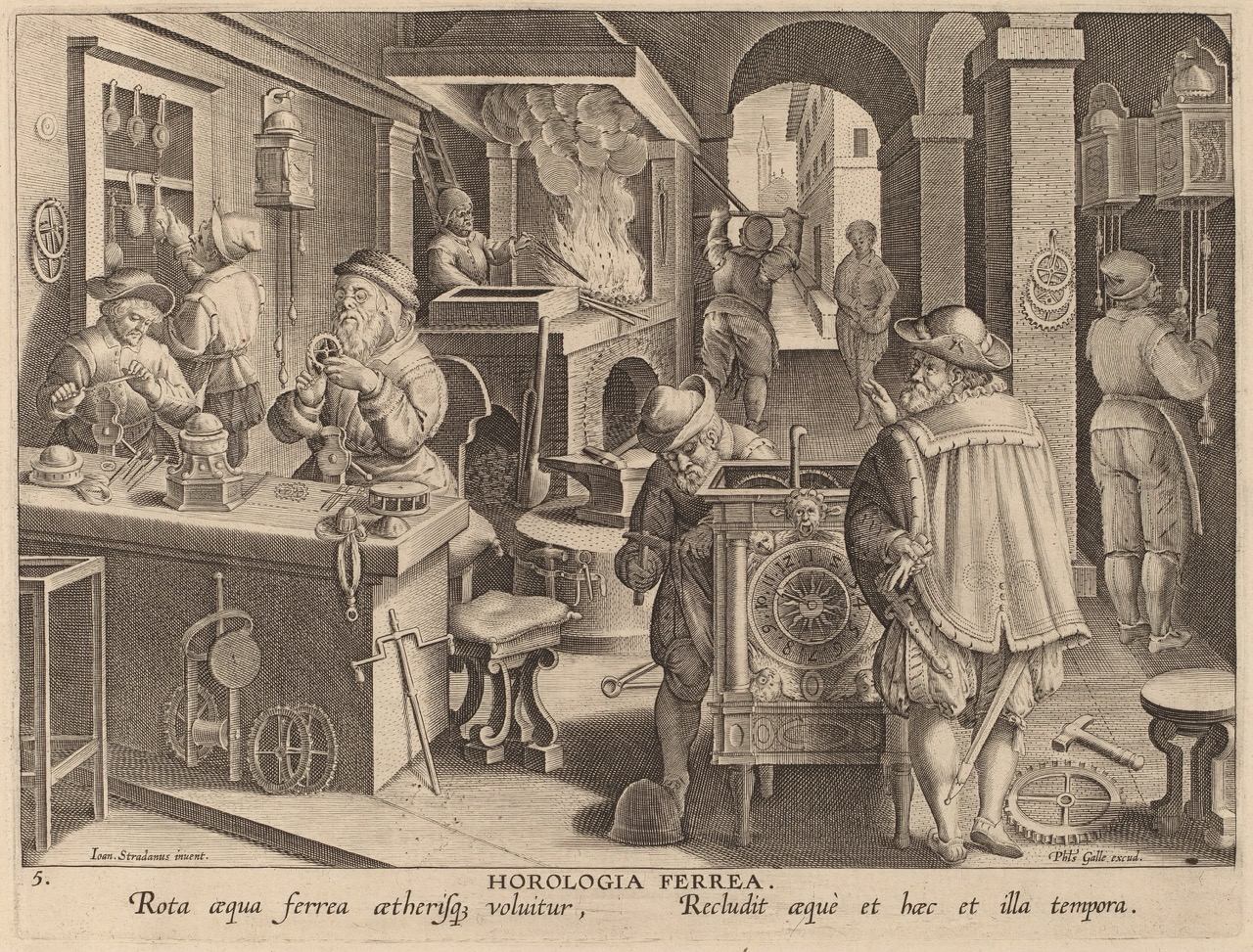
 Jan Collaert I (d’après Jan van der Straet, dit Giovanni Stradano ou Stradanus), L’Invention de l’horlogerie (Nova reperta, planche 5), publiée par Philips Galle, 1590-1600, estampe, 27 × 20 cm, New York, The Metropolitan Museum of Art, (34.30(6)).
Histoire de l’art, no 97 : Hiérarchies artistiques
VARIA
Florian Métral
L’horloge publique comme ornement de la cité. Discours, pratiques et représentations (XVe-XVIIe siècle)
Cet article analyse l’affirmation et la reconnaissance de l’horloge publique monumentale comme ornamentum civitatis à la Renaissance. À travers le Plaidoyez de Claude Expilly (1608), la série gravée Nova reperta de Giovanni Stradano (1590‑1600), l’iconographie des Enfants de Mercure et la tour de l’Horloge du pont de Grenoble (1603), l’horlogerie publique se fait l’instrument privilégié de la mise en scène, par le décor, de l’autorité souveraine de la cité. Dans le même temps, l’étude traite des conditions sociales d’ennoblissement de l’horloger, figure située au croisement des métiers techniques, des savoirs scientifiques et des pratiques artistiques, et qui redéfinit ainsi les frontières entre arts mécaniques et arts libéraux.
Télécharger l’article au format PDF.
The Public Clock as City Ornament: Discourse, Practices, and Representations (15th–17th Centuries)
This article examines the assertion and recognition of the monumental public clock as ornamentum civitatis during the Renaissance. Drawing on Claude Expilly’s Plaidoyez (1608), Giovanni Stradano’s engraved series Nova reperta (1590–1600), the iconography of the Children of Mercury, and the Clock Tower of the Pont de Grenoble (1603), it demonstrates how public clocks became privileged instruments for staging, through imagery, the sovereign authority of the city. At the same time, the study illuminates the social conditions underlying the ennoblement of the clockmaker—a figure positioned at the intersection of technical crafts, scientific knowledge, and artistic practice—who, through their work, helped redefine the boundaries between mechanical arts and liberal arts.


